Commissioning of high voltage cable systems
More and more complex cable systems are being built in today's infrastructure. Whether they supply power from wind farm production or supply power to critical industries, it is important to ensure that these systems can withstand the stresses they are subjected to.
All high voltage cables are tested in the factory before being delivered. Most grid owners also require the cables to be sheath tested after they have been installed. Although in most cases this testing assures the quality of the cable itself, these do not say anything about the quality of joints and terminations.
If you look at the statistics on cable breakdowns, most of the breakdowns are due to faulths in either joints or terminations.


So how ensure the quality of joints and terminations?
The only way to ensure that joints and terminations do not have faults when taking over the system is to perform isolation testing with PD analysis.
During an withstand test, the cable system is subjected to an overvoltage from 2 to 3 * cable operating voltage (Uo)
The purpose of this is to "provoke" a controlled breakdown in weaknesses that may be present in the installation. A withstand test itself will in most cases not be able to reveal normal installation errors such as;
- cuts and impurities in the pex surface
- poor semiconductor removal
- incomplete shrinkage
- incorrect installation of the field distributor
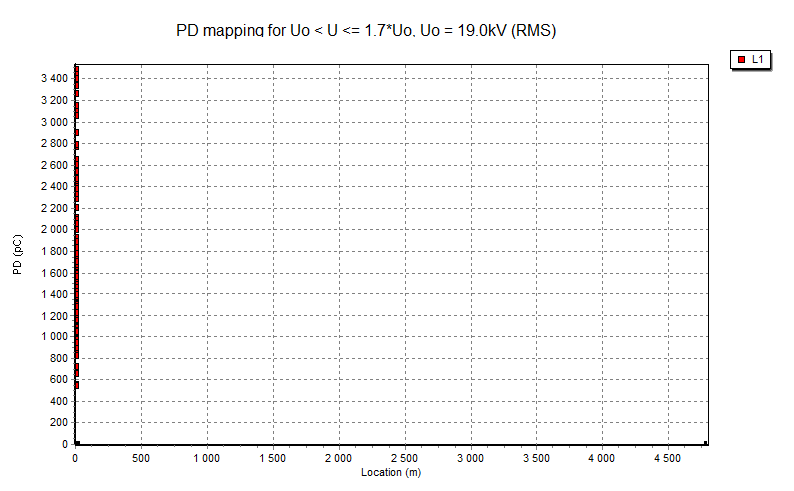
On the other hand, a monitored withstand test with PD diagnosis will reveal and localize this type of weakness!
When these weaknesses are put under an electric field, electric discharges will usually occur, also called partial discharges. In many cases the discharges will not be enough to cause a breakdown during the voltage test. However, since the test is combined with a PD diagnosis, these discharges will be detected and located.
A new cable installation should not show signs of partial discharges in cables, joints or terminations. If this is the case, then the installation has not passed the test.
Since the PD activity is located down to <1 meter, the faulth can be quickly rectified with minimal intervention. When the fault is rectified, the test is performed again.